Flow State: The Neuroscience of Peak Performance (and How to Access It On Demand)
By Eathan Janney, PhD
You’ve had the experience. You sit down to work and something shifts. Time disappears. The task stops feeling like work and starts feeling like the only thing that exists. Your output surprises you. An hour passes and it feels like ten minutes — or ten minutes passes and it feels like an hour.
Mihaly Csikszentmihalyi called it flow. He spent 30 years studying it. In the last decade, neuroscientists have started to understand why it happens — and that understanding opens a very practical question: can you make it happen on purpose?
The answer, based on the evidence, is yes — within limits. You cannot manufacture flow on command. But you can build the conditions that make it dramatically more likely. And for executives, entrepreneurs, and anyone whose output depends on their cognitive quality, this is one of the highest-return skills you can develop.
What Is Flow? A Precise Definition
“Flow” gets used loosely. Let’s define it precisely.
Flow is an optimal state of consciousness in which a person is fully immersed in a challenging activity. Csikszentmihalyi’s original research identified flow across an extraordinary range of contexts: chess players, rock climbers, surgeons, artists, musicians, factory workers, athletes. The subjective experience was remarkably consistent across all of them.

- Complete Absorption — attention is fully captured by the task at hand
- Altered Time Perception — time either slows dramatically or disappears entirely
- Effortless Effort — action feels automatic, not forced or labored
- Loss of Self-Consciousness — the inner critic goes quiet and stops interfering
- Intrinsic Reward — the activity becomes its own motivation and reward
- Sense of Control — mastery without feelings of anxiety or overwhelm
What makes flow interesting is not just that it feels remarkable. It’s that it performs remarkably. Research documents 3–5× improvements in creative output, dramatic increases in learning speed, and measurable boosts in problem-solving performance. McKinsey research on executives found leaders estimated they were 5× more productive in flow than out of it.
The Neuroscience of Flow: What’s Actually Happening in the Brain
For decades, flow was studied behaviorally — researchers could observe it and interview people about it, but couldn’t see inside the brain during it. That’s changed significantly with modern neuroimaging.
1. Transient Hypofrontality
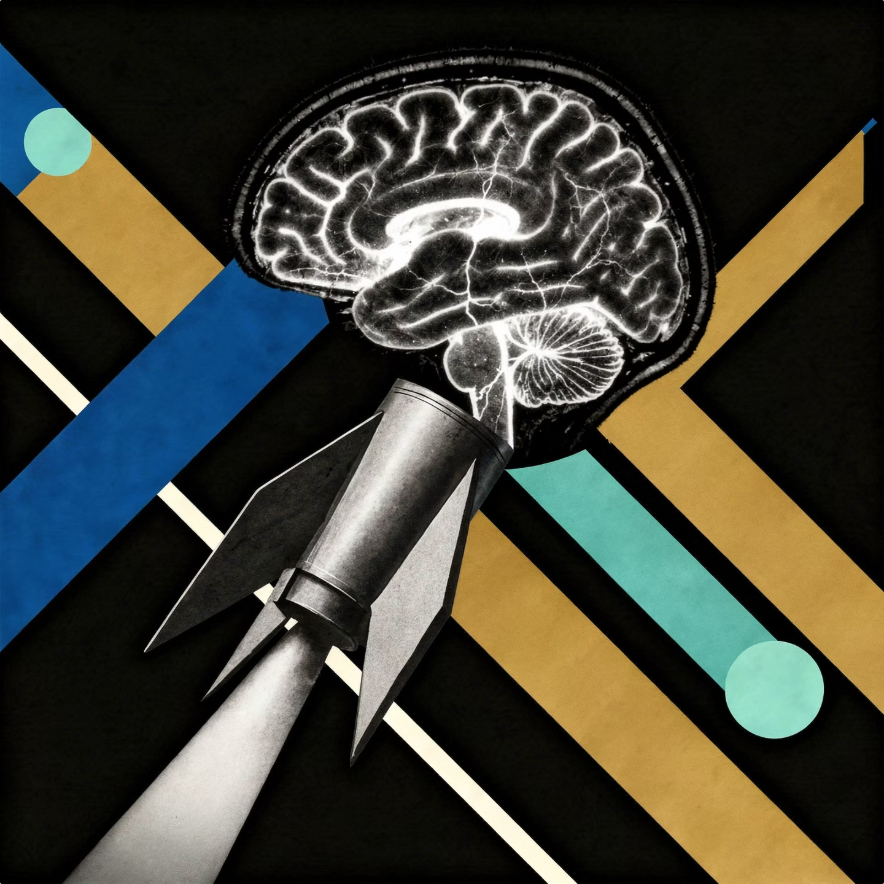
The most important neurological feature of flow is counterintuitive: parts of your prefrontal cortex shut down.
The PFC is the seat of self-monitoring, self-criticism, executive control, and the internal monologue that second-guesses everything. In flow, neuroimaging shows reduced activity across several prefrontal regions — a phenomenon researcher Arne Dietrich called transient hypofrontality.
The result is a brain operating without the constant overhead of self-regulation. The inner critic goes offline. Pattern recognition accelerates. Output flows more freely. This is why flow feels like less effort even though performance improves — you’re not working harder, you’re working with less interference.
2. The Neurochemistry of Flow
Flow states involve a distinctive cocktail of neurochemicals — one of the richest in human neurobiology:
Norepinephrine narrows attention, increases arousal, and prepares the system for high-performance output.
Dopamine elevates motivation, pattern recognition, and the sense that what you’re doing is meaningful. It’s also what makes flow intrinsically rewarding — the dopamine release is the reward, which is why you want to keep doing the thing you’re in flow doing.
Anandamide — the “bliss molecule” — expands lateral thinking and enables the associative leaps that drive creative insight. Also released by exercise, partly explaining the runner’s high and why exercise enhances creativity.
Serotonin contributes to the emotional positivity and sense of wellbeing that characterizes deep flow states.
Endorphins add to the sense of pleasurable effort during physical flow states.
This is not a single chemical experience. Flow is a full-system state — which is part of why it’s so powerful, and part of why it requires multiple conditions to be in place simultaneously.
3. The Default Mode Network and Flow
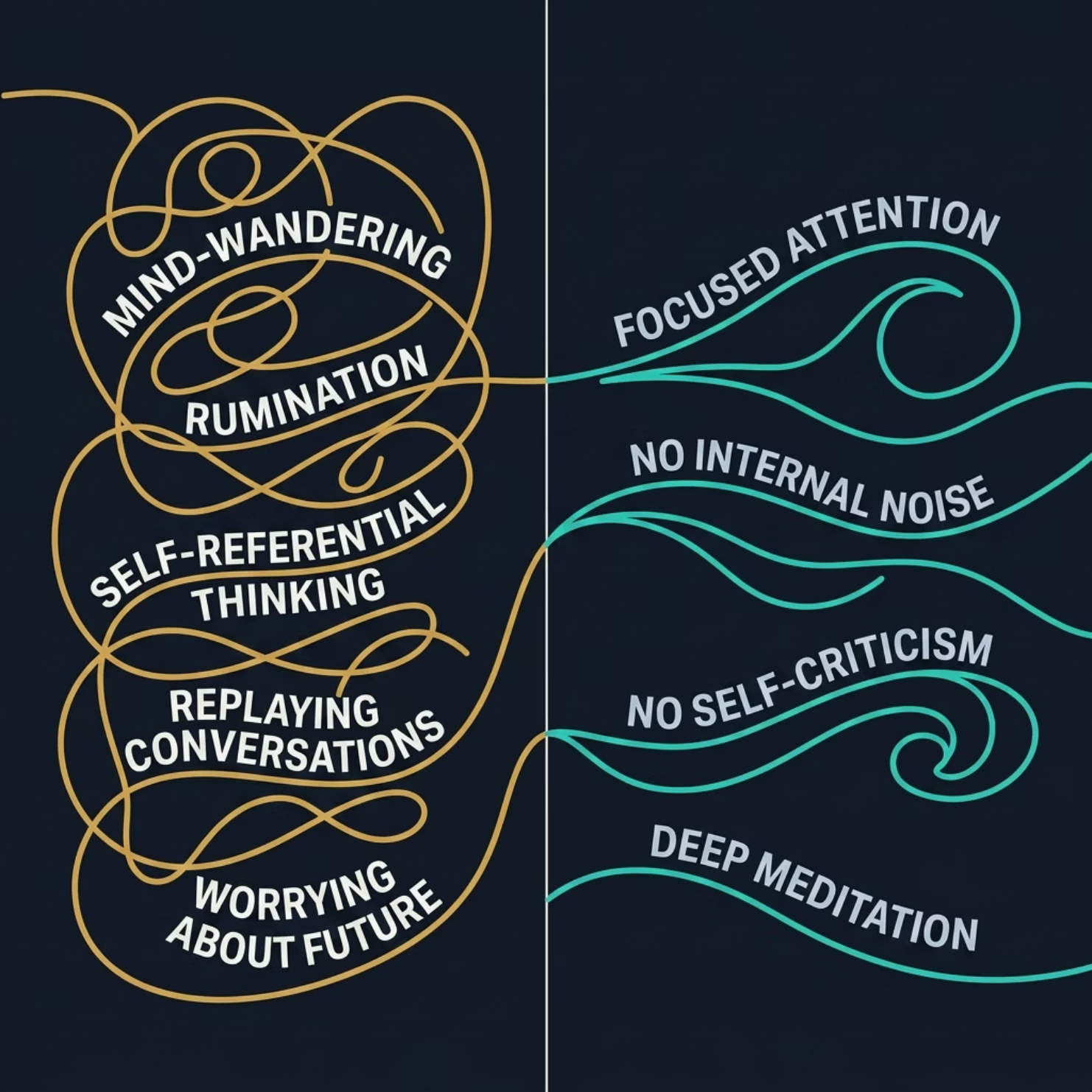
The Default Mode Network (DMN) is the brain’s “idle” circuitry — active when you’re not focused on a specific task, heavily involved in mind-wandering, rumination, and self-referential thinking.
In flow, the DMN quiets significantly. The internal noise — replaying conversations, worrying about the future, cataloguing to-do items — largely stops. This is neurologically similar to what happens during deep meditation, which may be why many practitioners describe both experiences similarly.
The practical implication: arriving at a deep work session with open loops and unresolved mental noise is working against your own DMN. A brief pre-session capture (writing down everything unfinished before you start) is neurological setup, not just organizational hygiene.
The Flow Channel: Why Challenge Matters
One of Csikszentmihalyi’s most enduring insights was the flow channel — the zone between anxiety and boredom where flow becomes possible.
The 4% Sweet Spot
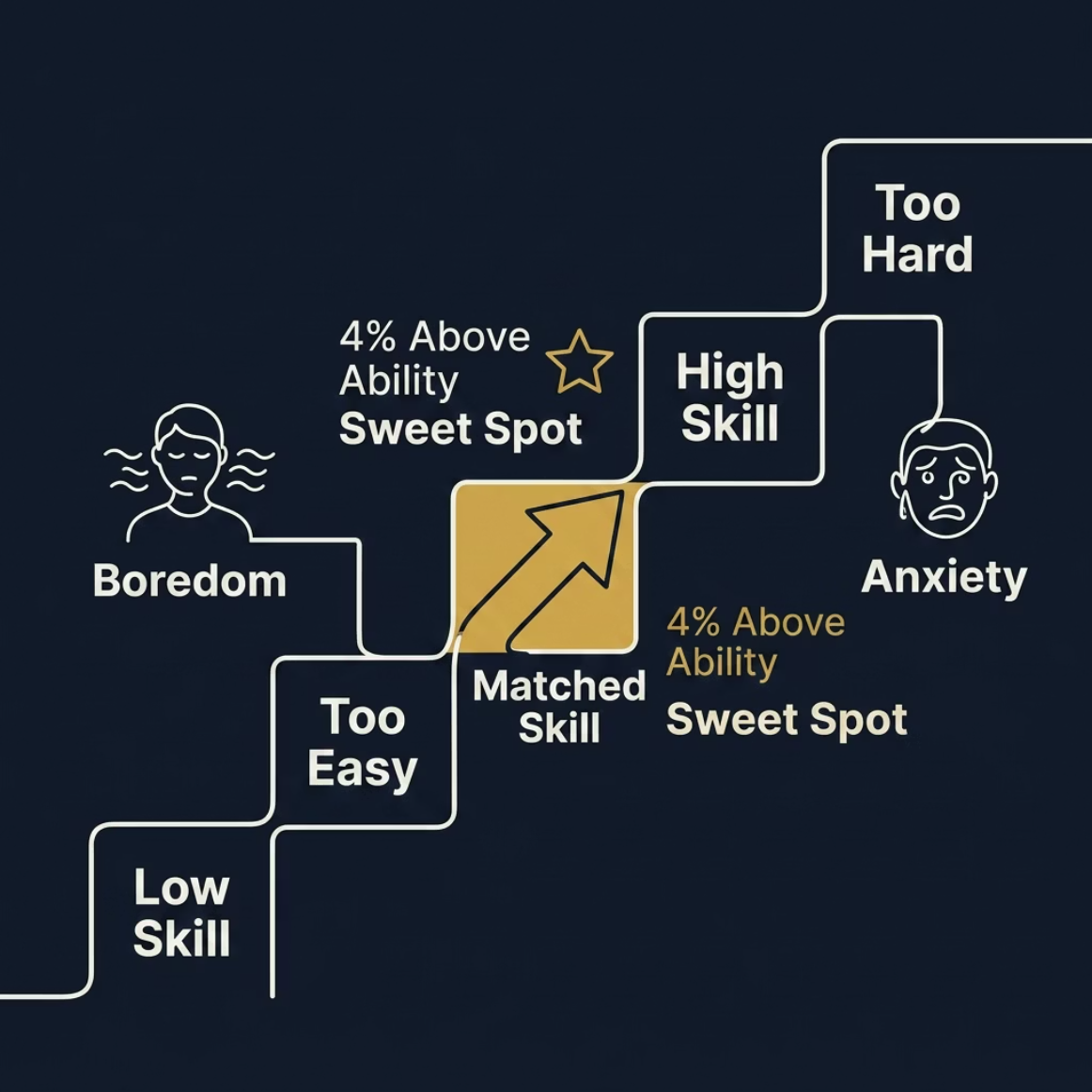
The skill-to-challenge ratio needs to be approximately 4% above your current ability level — enough to demand your full attention without overwhelming your capacity. Researcher Steven Kotler, who directs the Flow Research Collective, identified this as the “Sweet Spot.”
- Too easy + high skill → Boredom. The brain disengages. Flow is impossible.
- Too hard + low skill → Anxiety. The threat response engages. Flow is blocked.
- Optimal challenge + matched skill → Flow conditions are met.
For executives and entrepreneurs: work that is too routine will never produce flow. Work that is too far above your current capability will produce anxiety instead. The practical test — “Is this just hard enough that I have to really think, but not so hard I feel stuck?”
Flow Triggers: The Conditions That Invite Flow
Research on flow triggers provides the most actionable guidance for those who want to access flow more reliably. Kotler and colleagues at the Flow Research Collective have catalogued over 20 flow triggers, grouped into four categories.

Environmental Triggers
High consequences — the brain allocates attention preferentially to situations with real stakes. Meaningful deadlines, visible accountability, or genuine commitment to an outcome activates this trigger.
Rich environment — novelty, complexity, and unpredictability keep attention engaged. Working in a slightly unfamiliar location or on a novel aspect of a familiar problem can induce flow more readily than grinding at your usual desk.
Deep embodiment — physical presence and sensory engagement affect cognitive state, even when seated.
Psychological Triggers
Intense focus — the brain needs approximately 15–20 minutes of distraction-free work to shift into the early stages of a flow state. A single interruption resets the clock entirely. A 90-minute undisturbed block is not 3× better than a 30-minute block — it may be 10× better, because it actually allows flow to develop.
Clear goals — ambiguous goals produce cognitive load. Specific goals for the current session reduce decision overhead and allow full attentional engagement.
Immediate feedback — the brain needs to know in real time whether it’s succeeding. Sports provide this automatically. Knowledge work often lacks it — building milestones and checkpoints into your workflow helps compensate.
Challenge-skill balance — the most critical psychological trigger.
Creative Triggers
Pattern recognition — the brain is naturally engaged by making connections across domains. Cross-disciplinary thinking is a reliable flow trigger for intellectually-oriented people.
Creativity — genuinely creative tasks demand full mental engagement in a way that routine ones don’t. Novelty plus challenge is a potent combination.
Social Triggers
These apply to group or collaborative flow states — documented in sports teams, jazz ensembles, high-performance military units, and certain creative teams:
- Concentrated, undivided focus on the shared task
- Shared, clear goals everyone owns equally
- Open communication — including the ability to challenge
- Equal participation and matched skill levels (status hierarchy is flow’s biggest group blocker)
- Risk-taking with blended egos — individual recognition defers to the shared outcome
Practical Flow Protocol: Building Flow Into Your Work Week
Based on the research, here is an evidence-based protocol for increasing flow frequency and duration:
Step 1: Create Inviolable Deep Work Blocks
Pick 1–2 windows per day when you will be completely unavailable. Close communication tools. Eliminate notifications. Remove the phone from the room. A single notification resets the entire 20-minute on-ramp to flow.
Most executives don’t need more time to work in flow. They need to protect the time they already have.
Step 2: Match Task to Skill Level
Before each deep work block, choose a task that genuinely challenges you — but one you’re capable of completing. Ask: What is the most demanding thing I can do that I actually have the skills to execute right now?
Step 3: Set a Clear, Specific Goal for the Session
“Work on the project” is not a goal. “Write the executive summary for the Q3 board deck” is. Specificity reduces cognitive overhead and narrows attentional focus.
Step 4: Pre-Flow Rituals
Consistent pre-flow rituals condition the nervous system to shift states. Research on habit formation and athletes’ pre-performance routines shows behavioral sequences become neurologically linked to the states that follow them.
Your ritual might include: 5 minutes of slow breathing, a brief capture of open loops, a clear statement of your session goal, dedicated music, a brief physical movement sequence. The content matters less than the consistency.
Step 5: Protect the Post-Flow Recovery Window
Flow is metabolically expensive. The neurochemical expenditure during a peak flow state typically requires 20–30 minutes of recovery before the next flow state is accessible. Pushing immediately from one deep session into another without recovery produces diminished returns.
Build a short recovery buffer between deep work blocks: a brief walk, a few minutes of non-demanding activity, lunch without a screen. The rest enhances the next flow session; skipping it degrades it.
What Blocks Flow: The Most Common Obstacles
Chronic stress — elevated cortisol suppresses the neurochemistry of flow. If baseline stress is chronically high, flow becomes nearly inaccessible. Stress management is not separate from performance optimization — it is performance optimization.
Sleep deprivation — the prefrontal cortex is exquisitely sensitive to sleep quality. Tired brains struggle to reach flow states even when all other conditions are in place.
Digital interruption patterns — compulsive checking of email, messages, and social media trains the brain to expect interruption. Sustained attention becomes harder to achieve even when you deliberately want it.
Open loops — undone commitments, unresolved decisions, and unfinished tasks generate cognitive noise that loads the DMN. Capture systems reduce that overhead.
Multitasking as a habit — regularly switching between tasks trains the brain to expect context shifts. The neural pathways for sustained attention weaken with disuse.
Flow and the NeuroGenerative Framework
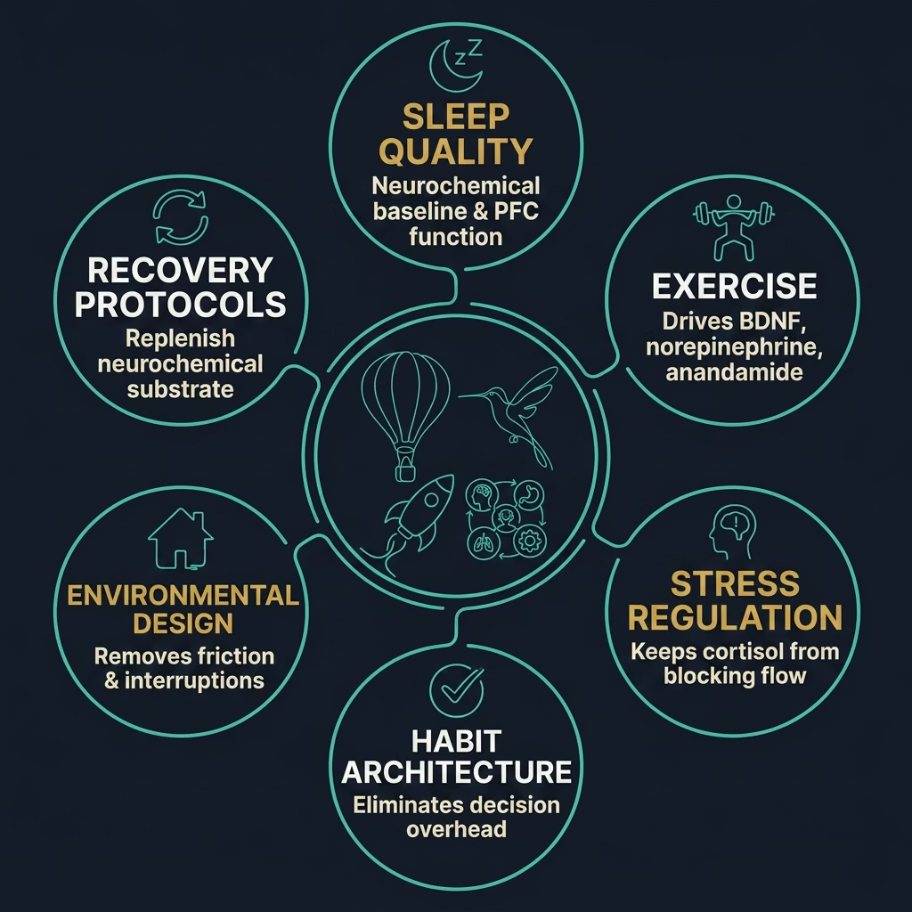
At NeuroGenerative Dynamics, we view flow state access as a downstream outcome of multiple upstream systems working in concert:
- Sleep quality → determines neurochemical baseline and PFC function
- Exercise → drives BDNF, norepinephrine, and anandamide — all flow precursors
- Stress regulation → keeps cortisol from blocking flow neurochemistry
- Habit architecture → eliminates decision overhead during work blocks
- Environmental design → removes friction and interruption triggers
- Recovery protocols → replenish the neurochemical substrate between flow sessions
This is why “just try to focus more” consistently fails for high performers. Flow is a systems phenomenon. It requires multiple conditions to be in place simultaneously.
The value of the NeuroGenerative approach is not any single protocol. It’s the construction of the underlying conditions — the system in which flow becomes not an occasional accident but a regular, reliable part of your performance architecture.
The Flow Recovery Window and Weekly Structure
Most high performers can sustain 3–5 hours of genuine flow per day — not continuous, but in 90-minute blocks with recovery periods between them.
A realistic weekly structure:
| Day | Flow Blocks | Notes |
|---|---|---|
| Monday | 1–2 blocks | Calibrate the week |
| Tuesday–Thursday | 2–3 blocks/day | Peak performance window |
| Friday | 1–2 blocks | Review and planning |
What matters is that flow blocks are scheduled before other commitments fill the calendar — not found in the gaps that remain.
Start Here
If you’re not currently experiencing regular flow states at work, the first step is not optimization. It’s protection.
Protect one 90-minute block each morning. Remove all interruptions. Pick one meaningful, challenging task. Let the neuroscience do the rest.
Once you understand what you’re protecting toward, the motivation to actually protect it tends to follow.
Ready to build the underlying systems that make flow a reliable part of your performance? Download our free NeuroPerformance Field Guide — the evidence-based starting point for high performers ready to close the gap between knowing and doing.
Or if you’re ready to explore a personalized protocol, schedule a discovery call.
Eathan Janney, PhD is a neuroscientist and performance coach at NeuroGenerative Dynamics.